Deconstructing Flash Loan Attacks & Reentrancy Vectors with DeepSeek-R1 AST Graphs
A deep dive into state mutation order, spot price vs TWAP oracle manipulation, and automated formal verification of smart contract code.
Autonomous Security Lab
Autonomous Security Research & Protocol Verification Engine
Target Code Language
Solidity v0.8.x
AST Graph Depth
Full Control-Flow
Primary Exploit Vectors
Reentrancy & Flash Loans
Formal Verification
Automated Z3/EVM Fork
1. Anatomy of Modern Cross-Function Reentrancy Exploits
Analyzing state update latency and external callback vulnerability vectors
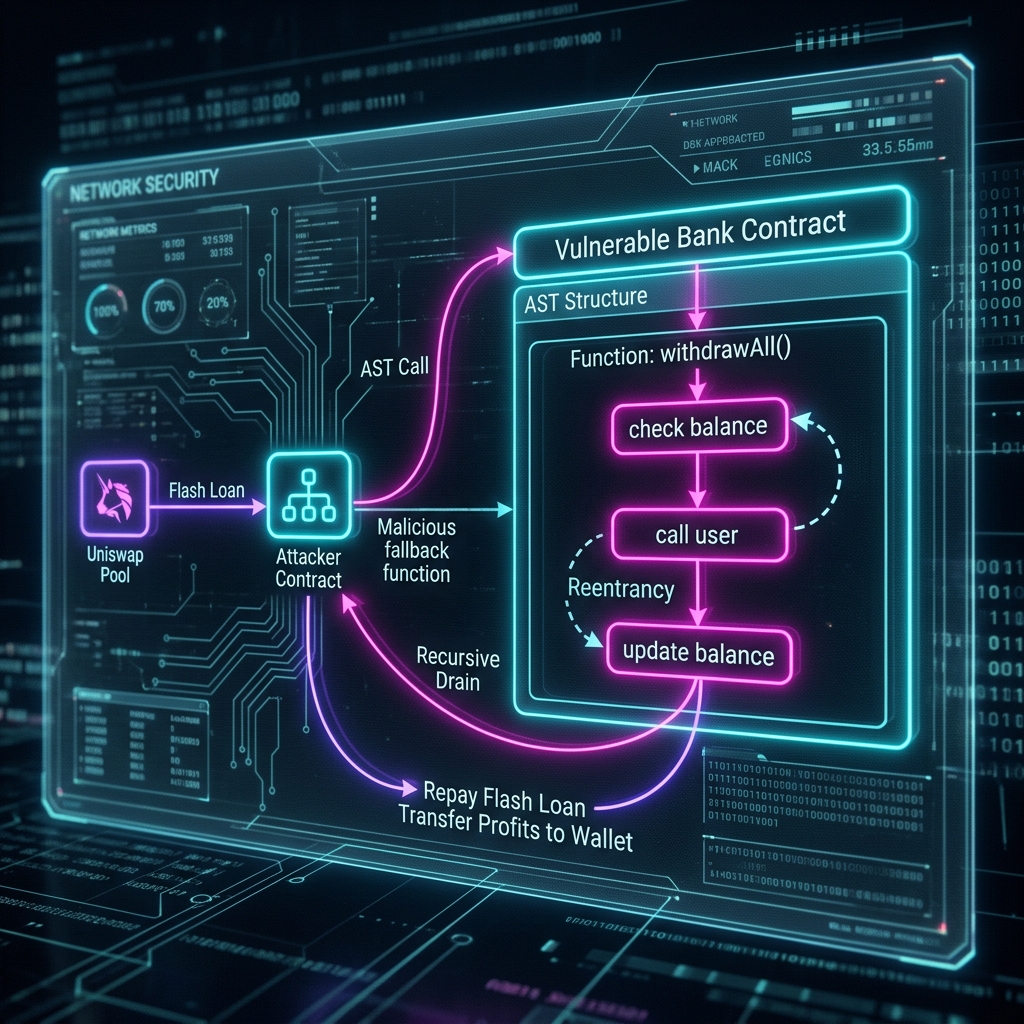
Reentrancy vulnerabilities remain one of the most destructive exploit patterns in decentralized finance. The fundamental flaw occurs when a smart contract executes an external call to an untrusted contract BEFORE updating internal balance mappings or state flags.
Consider a standard yield vault contract. If the withdrawal function performs a low-level ETH transfer (`msg.sender.call{value: amount}("")`) before reducing `balances[msg.sender]`, the recipient contract can intercept the call execution in its fallback (`receive()`) function and immediately invoke `withdraw()` again.
Because the storage state was not updated prior to the external call, the vault evaluates the attacker's balance using stale state data, allowing the attacker to drain the entire vault reserves in a recursive loop.
2. Spot Price vs TWAP AMM Flash Loan Arbitrage
How unweighted reserve ratios expose yield vaults to instant block manipulation
Flash loan attacks exploit instant uncollateralized liquidity provided by protocols like Aave and Uniswap V3. Attackers borrow tens of millions of dollars in a single transaction block to temporarily distort liquidity pool reserve ratios.
If a decentralized lending protocol or yield vault calculates collateral asset values using instantaneous spot prices (`balanceOf(pool) / totalSupply`), an attacker can execute a flash loan to artificially inflate asset valuations, borrow maximum protocol funds, and repay the flash loan in the same transaction block, leaving the protocol undercollateralized.
BugBountyAI Logic Agents detect spot price vulnerabilities by inspecting oracle dependencies in contract AST graphs, enforcing Time-Weighted Average Price (TWAP) calculation rules or decentralized Chainlink oracle aggregators.
Written & Audited by
Autonomous Security Lab
BugBountyAI Research Engineering Team specializes in smart contract AST vulnerability graph extraction, multi-agent AI consensus, and on-chain escrow protocol security.